Cat6a cabling supports 10Gig Ethernet, whereas Cat6 supports 10Gig Ethernet only for links up to 55m.
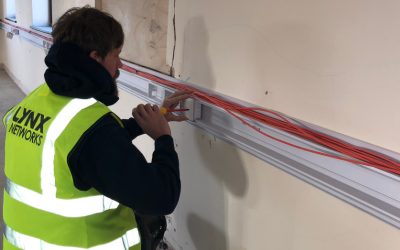
Cat6a has some disadvantages, and you need to weigh them for any particular application. On average, a Cat6a installation will cost about 50% more than Cat6. However, the main issue, and another influence on the overall cost, is that the cable and containment will need to be approximately double the cross-section. This includes risers, voids, cable trays, cable baskets, floor ducting and perimeter trunking; the minimum bend radius of installed Cat6a is upwards of 30mm.
If it’s for a new building or your premises are undergoing a major refit, it is easy enough to specify larger pathways and containment for your cabling systems. If, however, you’re hoping to use existing containment and pathways, you may have to think again because the cost and disruption may make Cat6a unjustifiable.
You need to ask yourself whether, for the life of the cabling, you ever need it to support 10Gig Ethernet? Whether it’s a backbone link, for a wireless AP, in a data centre, or in use for over ten years, the answer is more likely to be yes. Bear in mind that 10Gig active hardware will be more expensive than Gigabit hardware, but the cost differential has reduced considerably.
The IEEE 2.5GBASE-T and 5GBASE-T standards provide faster links over short distances on Cat6, although these are primarily intended for cabling to wireless APs.
You can save money by using Cat5e cords if you’re not yet implementing 10Gig Ethernet, but some manufacturers only give a “channel link” warranty that, by definition, includes the cords.
Most Cat6a cabling systems are shielded, and it is crucial that the building’s earth system is of a good standard and that competent electricians earth-bond the cabling system. Good earthing ensures that high-frequency noise is removed from the system via the shielding and helps prevent alien crosstalk between adjacent cables. If your earth system is not up to standard, you may need to invest in improvements.