What cabling system should you specify for your LAN? The decision depends on several factors:
- Network speed
- Power over Ethernet (PoE) requirements
- Distance
- Indoor vs outdoor data cabling
- The capacity of your cable routes
- Your budget
Trends
Cat5e is still capable of supporting 1Gbps Ethernet, but Cat6 has become the normal choice for new installations because it provides greater performance headroom at relatively modest additional cost.
Cat6a is increasingly specified where 10Gbps to the desktop or longer 10Gbps links may be required.
Copper cabling is still the primary method to get Ethernet to desks but WiFi can serve this purpose in some environments.
Distance and speed
Cat6a cabling can deliver speeds of 10Gbps (gigabits per second) for channels up to 100m (a channel includes the patch leads).
Cat6 can deliver 10Gbps to distances of up to 55m with the right design, installation and environment, or 1Gbps up to 100m.
Cat5e shouldn’t be used for links faster than 1Gbps.
OM4 multimode fibres support 10Gbps up to 550m and 100Gbps up to 150m depending on the transceivers and Ethernet standard used..
Single-mode fibre, typically OS1 or OS2, can handle greater distances and is now often used in campus backbone links.
What about PoE?
All three copper categories (Cat5e, Cat6 and Cat6a) will support standard PoE, but higher-power PoE applications make cable size, bundle size, ambient temperature and installation method increasingly important.
Fibre cable doesn’t support PoE unless it has a suitable parallel copper connection.
Shielding
In practice, most Cat6 cables are unshielded whereas most Cat6a cables are shielded. Shielding, when correctly bonded, offers protection from electromagnetic interference and alien crosstalk (crosstalk between cables). This can be a benefit in areas such as factories where electrical noise can be high.
Unshielded Cat6a cables generally have a thicker diameter.
Exterior and Outdoor Data Cabling
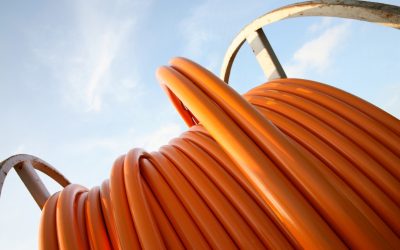
If your data cabling is going between buildings, it should be optical fibre to avoid a metallic path between buildings. It prevents problems associated with differences in earth potential and lightning-induced electrical surges.
If a cable is going outside but re-entering the same building you can use copper cabling with an external grade polyethylene jacket but, because of its poor fire properties, the cable should not extend far inside a building. Therefore, it may have to be joined to an internal grade cable. Joining will reduce the performance of the link but, done properly, this should not be an issue.
Size of data cables
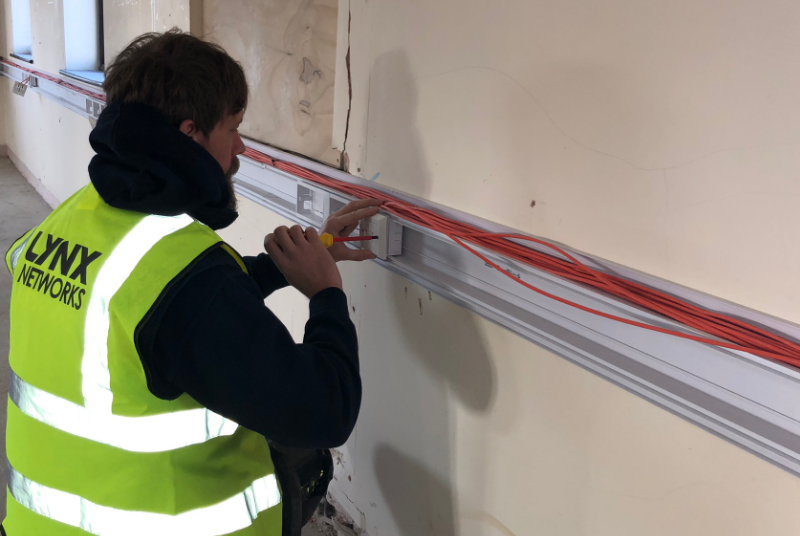
The higher the grade of copper cable, the more space you will need in your cable routes and containment. For example, the shielded Cat6a cable Lynx Networks uses is twice the cross-sectional area of our Cat6 and has a minimum bend radius of around 32mm.
This matters because::
- Existing trays and trunking may not have sufficient capacity
- Larger cables reduce the number of cables that can be installed
- Bend radius affects containment design
- Cable weight can become relevant in large installations
- Larger cables will make installation more labour-intensive
Cost differences
Based on our experience, when you take the everything into account, Cat6a is 30% to 60% more expensive than Cat6.
Optical fibre is much more costly when you take the cost of the electronics into account.
Conclusions
Cat6 cabling is normally the best choice but select:
- Cat5e – If 1Gbps is sufficient and your budget or space won’t allow for anything better
- Cat6 – The sensible default for most occasions
- Cat6a – Where 10Gpbs is required up to 100m (channel) now or in the future
- Shielded cable where the system design requires it or it’s in electrically noisy environments
- Multimode fibre – For building-to-building links up to 550m, high-bandwidth backbone connections, or where electrical isolation is required
- Single-mode fibre – Where the hardware dictates it and where links are more than 550m
There isn’t one cable that’s right for every application.
The best choice depends on the required bandwidth, distance, PoE requirements, installation environment, available containment and expected life of the installation.
For most office networks, Cat6 provides an excellent balance, while Cat6a and fibre become increasingly attractive as bandwidth, distance and future requirements increase.